
Hispanic Heritage Month September 17–October 8, 2026
The African roots of Latin music
Four programs from the Afropop Worldwide archive: Colombian cumbia, the Afro-Mexican story behind “La Bamba,” a journey from Cartagena to Quito, and Dominican bachata.
About the collection
The African history in
Latin American music.
Skip to the programs ↓Africans arrived in Mexico with the first Spanish ships.
By 1793 the census counted people of African descent at a tenth of the population,
1 in 10 · Mexico’s census, 1793
and most of that history was written out of the national story afterward.
On Colombia’s Caribbean coast, African and Indigenous rhythms met and became cumbia,
which spread through most of Latin America over the following century.
“…from the borderlands of Texas down the spine of the Andes to the tip of Tierra del Fuego.”
These programs come from the Afropop Worldwide archive: a concert by Colombian accordionists at a New York club, a road trip through Afro-Mexico, a program that begins in Cartagena and ends in Quito, and a portrait of Dominican bachata.
Four programs, four ways into the African roots of Latin American music.
Resumen en español
Cuatro programas del archivo de Afropop Worldwide exploran las raíces africanas de la cumbia colombiana, la música afromexicana, los sonidos de Colombia y Ecuador y la bachata dominicana. Esta guía presenta a los artistas, las historias y las tradiciones que conectan estas músicas.
Maestros de Cumbia
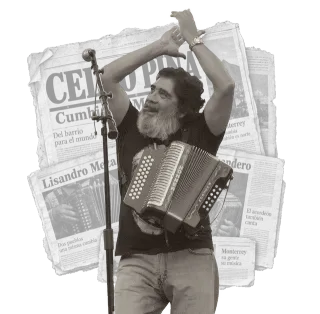
Follow the accordion from Colombia’s Caribbean coast to Monterrey, with Lisandro Meza’s New York live set at the center.
The confirmed recording is available.
At New York’s Copacabana, accordionist Lisandro Meza brings Colombian cumbia to the dance floor. The program pairs that live set with Andrés Landero and Mexico’s Celso Piña, painting a full portrait of cumbia, a music born out of the encounter between African and Indigenous traditions on Colombia’s Caribbean coast.
Read the original program notes ↗The accordionists
COLOMBIA · SUCRE
Lisandro Meza
As a boy on his father’s farm, Meza practiced in secret on a farmhand’s accordion, putting it back in its case before the owner came in from the fields. He joined Los Corraleros de Majagual in 1961. His live set puts the accordion at the center of the dance floor.
COLOMBIA · BOLÍVAR
Andrés Landero
In San Jacinto, Landero moved melodies from the gaita onto the accordion. He kept the tambora and llamador drums underneath. His touring carried that sound through Venezuela, Panama, the Dominican Republic and Mexico.
MEXICO · MONTERREY
Celso Piña
Piña taught himself accordion and built his career in Monterrey playing Colombian cumbia. His recordings extend this program’s gathering of maestros across the border.
La Bamba: The Afro-Mexican Story
Listen for the deep voice of the leona, the strings of the chilena and the orchestras keeping danzón alive in Mexico City.
The confirmed recording is available.
Ritchie Valens’s 1958 hit began as a son jarocho tune from Veracruz. In this Hip Deep episode, Marlon Bishop and Nina Macintosh follow Mexico’s African “third root” through Veracruz, the Costa Chica and the old dance halls of Mexico City.
Read the original program notes ↗A road trip through Afro-Mexico
01 / VERACRUZ
The leona and the fandango
The jarana, requinto and leona anchor son jarocho’s all-night fandangos. Don Delio, born Lucas Morales Vidal, played leona in Chacalapa, southern Veracruz. Afropop visited him in 2013 through Los Cojolites, part of the revival returning jaranas to younger hands.
The leona and the fandango: Afropop field notes02 / COSTA CHICA
A harpist making a living
In 2013, Afropop met Eulalio Gallardo, one of the Costa Chica’s last chilena harpists. Mariachi gigs and a rented-out speaker system helped pay his bills. The communities seeking recognition in that reporting would later be recognized in Mexico’s constitution in 2019.
A harpist making a living: Afropop field notes03 / MEXICO CITY
Danzón in the dance halls
Mexico City’s old dance halls keep Afro-Cuban danzón in circulation, with orchestras such as Acerina y su Danzonera. Historian Ben Vinson III and ethnomusicologist Alejandro Madrid connect the music to a longer history of Africans in Mexico, beginning with the first Spanish ships.
Danzón in the dance halls: Afropop field notesA Journey from Colombia to Ecuador
Travel from Joe Arroyo’s salsa and the accordion of vallenato to Paulina Tamayo’s Ecuadorian música nacional.
The confirmed recording is available.
The program starts on Colombia’s Caribbean coast in Cartagena, with Joe Arroyo, Carlos Vives and vallenato, plus early Shakira from before she was known outside Colombia. It ends in Quito, at a festival of national music where Paulina Tamayo sings live.
Related archive: Joe Arroyo, Paulina Tamayo ↗From the Caribbean to the Andes
01 / CARTAGENA
Joe Arroyo
Born in Cartagena in 1955, Arroyo sang with Fruko y sus Tesos for ten years before leading his own band. His 1986 song “La Rebelión” returns to colonial Cartagena and an enslaved man’s resistance, becoming one of Colombia’s best-known salsa records.
02 / CARIBBEAN COLOMBIA
Carlos Vives
Carlos Vives brings in vallenato, the accordion song form of Colombia’s Caribbean region. Alongside it is Shakira from her Colombian years, before she began recording in English. Together they widen the Colombia leg beyond the sound of Cartagena’s salsa.
03 / QUITO
Paulina Tamayo
In Quito the program goes to a festival of national music for a live recording of Paulina Tamayo, known at home as La Grande. She sang Ecuador’s música nacional: pasillo, albazo and sanjuanito. Tamayo died in October 2025; this archive performance brings Andean and popular traditions into the Ecuador leg.
Santo Domingo Blues: The Story of Bachata
The interplay of guitar and voice, carrying stories of love, hardship and everyday life.
Listen from October 8, 2026, at midnight Eastern Time. The recording link will appear when confirmed.
Once dismissed by Dominican elites as the music of cabarets and the poor, bachata became an international sensation. Filmmaker Alex Wolfe brings live ambience and the stories of Luis Vargas, Antony Santos, Aridia Ventura and Raulín Rodríguez to this portrait of a music that gives everyday feelings a public voice.
Read the original program notes ↗The voices of bachata
01 / LUIS VARGAS
The guitar and the voice
Luis Vargas is at the heart of Alex Wolfe’s documentary portrait of bachata. The radio program’s cue sheet includes a live recording of “Veneno” and his “El Macho”, bringing the guitarist and singer into focus.
Program cue sheet ↗02 / ANTONY SANTOS
Bachata tells its own story
Wolfe brings the voice of Antony Santos into the program alongside Vargas. The music selections include Santos’s “Voy p’allá”, letting the songs sit alongside the artists’ stories.
Afropop program archive ↗03 / ARIDIA VENTURA
A woman answers back
Aridia Ventura’s songs gave voice to women’s anger and disappointment in love. Listen for “Tú no eres varón” and “No te me despegues más”, both listed in this program’s cue sheet.
Aridia Ventura / iASO Records ↗